The Displacement Continuum
Provides a governance diagnostic by identifying where institutional responsibility breaks down as people move across legal categories, jurisdictions, public systems and phases of displacement.

Research Agenda
How responsibility for displaced populations is assigned, financed and sustained across institutions and public systems.
Displacement is experienced as a continuum, while governance is organised through fixed legal categories, territorial jurisdictions, institutional mandates and financing arrangements.
The result is often institutional discontinuity. Responsibility, eligibility, data, services and financing fail to move with people as they cross borders, jurisdictions, administrative categories and phases of displacement.
Displacement Policy develops research, comparative evidence and policy frameworks to understand these fault lines — and to identify how responsibility and protection can be sustained more effectively over time.
Displacement Policy’s research is organised around three connected analytical lenses: the displacement continuum, sustainable inclusion and political economy.
Provides a governance diagnostic by identifying where institutional responsibility breaks down as people move across legal categories, jurisdictions, public systems and phases of displacement.
Examines how displacement-related functions and access can be sustained through ordinary institutions and public systems where legitimate and feasible, including the institutional, fiscal and administrative arrangements required for continuity.
Examines why institutional discontinuities persist, how interests and incentives shape the terms of inclusion, and what forms of reform are politically, institutionally and fiscally feasible.
Together, these lenses move analysis from identifying where responsibility breaks down to examining what continuity would require and under what conditions reform can be sustained.
Explore the Analytical Framework →
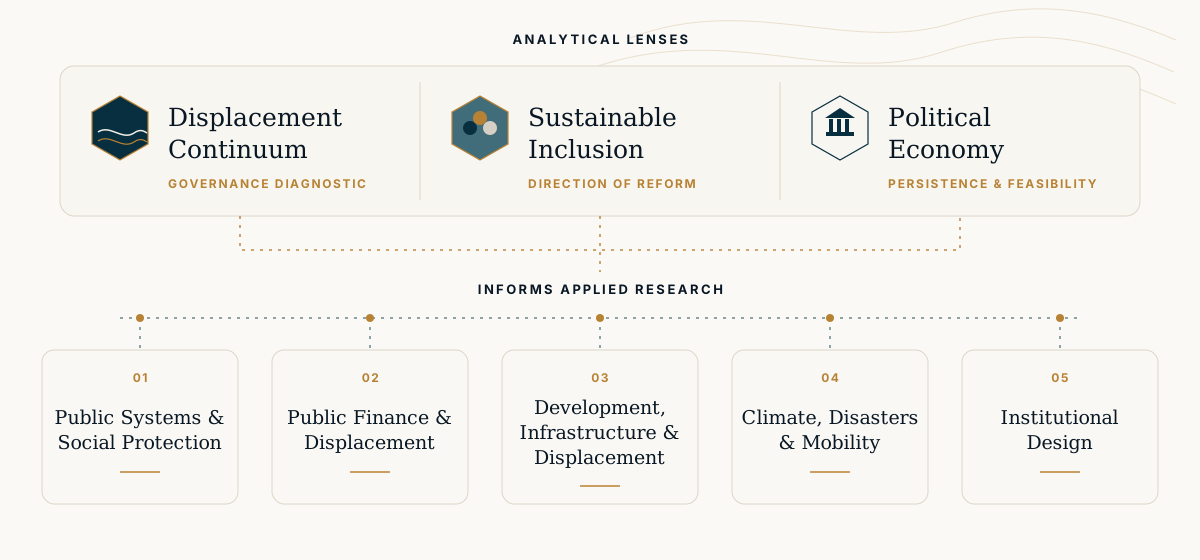
The analytical framework is applied to major public policy questions relevant to displacement. Each research area examines a distinct institutional and policy problem while contributing to the wider Governing Displacement research agenda.
The framework is applicable across different governance systems and forms of displacement. Refugee hosting, conflict-induced internal displacement, disaster and climate mobility, and development-induced displacement create different configurations of institutional responsibility, fiscal capacity, territorial authority and international cost-sharing. This variation provides a basis for examining which governance constraints recur across displacement and which are specific to particular political, institutional or fiscal contexts.
Examining whether ordinary public systems can respond not only to shocks, but to mobility.
Research focuses on how social protection, health, education, civil registration and other public systems can maintain access as people move across jurisdictions, administrative categories and phases of displacement.
Key questions include portability of benefits, eligibility across jurisdictions, interoperable registries, identification, duration-sensitive support and the relationship between humanitarian assistance and national systems.
The wider question is whether systems designed around stable populations and fixed administrative categories can maintain protection and access as people move.
Examining how displacement-related responsibilities and expenditure are recognised, allocated and sustained through public and sovereign fiscal systems.
Displacement-related expenditure is often financed as exceptional or temporary even when its consequences become recurrent.
Research focuses on the fiscal architecture underlying displacement: national and subnational budgets, intergovernmental transfers, medium-term expenditure arrangements, contingency financing and other mechanisms through which displacement-related costs and responsibilities are distributed and sustained over time.
A central challenge is the recurrent obligation problem: how expenditure initially financed as temporary or exceptional becomes a continuing public responsibility, and how that responsibility can be reflected in ordinary fiscal systems without assuming that all associated costs must ultimately become domestic.
The research examines how fiscal systems reproduce categorical, temporal and territorial fault lines; how budget and financing arrangements shape incentives for inclusion; and how displacement-related pressures interact with fiscal space and sovereign resilience.
Research also examines how different fiscal and institutional constraints require different financing responses — and how the choice of sector, instrument, financing terms and results should follow from that diagnosis.
A particular focus is the relationship between governance architecture and fiscal architecture: whether resources reach the institutions and jurisdictions carrying responsibility, how costs shift across levels of government, and how fiscal arrangements respond as displacement changes in scale, location or duration.
Development investments can generate displacement while also shaping the institutions that respond to it.
This area examines how infrastructure finance, environmental and social safeguards and development-bank operations connect project-based displacement responses with longer-term public responsibility.
The focus extends beyond compensation and project compliance to the institutions that sustain responsibility after project closure: public services, social protection, local government, financing and continuing support for affected populations.
A central question is what happens when project obligations end but displacement-related vulnerability continues.
Climate change and disasters increasingly expose the limitations of systems designed around temporary shocks and fixed populations.
This area examines disaster and climate displacement as one application of the wider Governing Displacement framework. Research considers how disaster risk management, adaptive social protection, anticipatory action, planned relocation, adaptation and resilience financing connect with the institutions responsible for people before, during and after movement.
A particular focus is the relationship between emerging legal and policy approaches to avert, minimise and address displacement and the public systems and financing arrangements required to implement them. This includes how responsibilities and expenditure change across emergency response, recovery, relocation and longer-term inclusion; how receiving areas absorb population movement; and how temporary or exceptional interventions connect with sustained institutional responsibility.
The wider question is how climate and disaster governance can address mobility without creating new categorical, territorial or temporal discontinuities.
Examining how responsibility is maintained when displacement crosses legal, territorial and institutional boundaries.
Displacement can move people across legal statuses, administrative jurisdictions, territorial authorities and cross-border frameworks through which responsibility is assigned differently.
Research focuses on how responsibility is allocated and transferred across local, national and regional institutions; how legal protection interacts with administrative systems; and how public functions are maintained as people move between jurisdictions or where authority and territorial reach are fragmented or contested.
The research also examines where sector-specific or administrative forms of inclusion may be possible when comprehensive legal-status reform is politically constrained, and where reliance on ordinary public systems may itself be limited by institutional capacity, protection concerns, legitimacy or territorial control.
The wider question is how responsibility can remain identifiable and workable when the legal, territorial or institutional architecture through which it is normally organised does not align with the realities of displacement.
FLAGSHIP RESEARCH PROGRAMME
Financing Displacement Governance is a cross-cutting research programme spanning the applied research areas.
Displacement is often framed as a problem of insufficient financing. The underlying challenge is more fundamental: how displacement changes public functions, institutional responsibilities and expenditure, where the resulting fiscal and institutional constraints arise, and what financing is intended to accomplish in response.
The programme examines the wider financing architecture of displacement governance: how responsibilities and costs are distributed across national and subnational governments, public systems, humanitarian actors and international financing; how those arrangements change as people move or displacement becomes prolonged; and how exceptional or externally supported responses connect with ordinary institutions and budgets over time.
The research starts from fiscal and institutional diagnosis rather than from a financing instrument. It asks which public or protection functions are affected by displacement; which institutions actually carry responsibility and expenditure; where fiscal capacity, territorial allocation, institutional rules, volatility or recurrent financing constrain the response; and what combination of institutional change and financing may be required.
The objective is to connect that diagnosis with existing public, development, sovereign, humanitarian, climate and disaster-financing arrangements rather than assume that displacement requires a separate financing architecture. The programme connects public finance with social protection, infrastructure and development investment, climate and disaster financing, humanitarian transitions and multilevel governance, and is designed for application across different displacement settings.
Displacement Policy’s research agenda is global in scope. Southeast Asia provides its initial regional evidence base and a comparative setting in which to examine broader questions about displacement governance.
The Southeast Asia Governance Mapping examines how countries across the region organise responsibility for displacement through laws, institutions, public systems and policy instruments.
Southeast Asia provides a particularly valuable setting for this work. States combine significant administrative capacity and increasingly sophisticated systems for social protection, disaster management, migration governance and public service delivery with diverse legal and political approaches to refugees, internal displacement, statelessness, disasters and mobility.
The mapping identifies where responsibility is assigned, where it becomes fragmented, and how governance systems respond as people move across legal categories, territorial jurisdictions and phases of displacement.
Its purpose is not simply to catalogue policies. It provides an empirical base for comparative research on institutional continuity, sustainable inclusion, public finance and political economy, while generating propositions that can be examined and developed in other regions.
The research agenda is advanced through a combination of independent research, comparative evidence, external perspectives and collaborative policy engagement.
A cumulative series developing the institutional, public-system and financing architecture of displacement governance through focused policy propositions.
Longer research developing conceptual, comparative, empirical or technical dimensions of displacement governance.
Regional comparative evidence on how displacement is governed across laws, institutions, public systems and policy instruments.
Contributions from practitioners, policymakers and scholars bringing distinct institutional and disciplinary perspectives into the research agenda.
Research developed with partners around specific governance, public-system, financing or institutional reform questions.
Expert discussions and collaborative policy processes designed to connect fields that are often treated separately, examine emerging ideas against practice and identify new directions for research.
Displacement Policy is developing a Displacement Governance Diagnostic that translates the research framework into a structured approach for identifying where institutional continuity breaks down and what would be required to sustain responsibility over time.
Applied work could trace displacement trajectories and the public or protection functions they affect; identify how responsibility is formally assigned and where it is actually exercised; examine the institutional, political-economy, administrative, territorial and fiscal constraints shaping the response; and develop context-specific options for reform. Where financing is a material constraint, analysis could also examine where expenditure and fiscal responsibility fall, how existing financing arrangements affect institutional responses, and what forms of financing may be required to support feasible reform.
The objective is not to prescribe standardised solutions. It is to connect research with practical reform questions:
Depending on the context, applied work may therefore include institutional and system diagnostics, political-economy analysis, fiscal and financing analysis, comparative reform options and structured policy dialogue. These applications also generate evidence through which the wider Governing Displacement framework can be tested and refined.
Such work may be developed with governments, development institutions, international organisations, researchers and practitioners while remaining grounded in Displacement Policy’s independent research agenda.