
ANALYTICAL FRAMEWORK
How displacement governance breaks — and how institutions can sustain responsibility
A framework for analysing where institutional responsibility fragments, what is required to sustain displacement-related functions and responsibility, and which forms of reform are politically, institutionally and fiscally feasible.
When institutional design produces discontinuity
Displacement is commonly governed through legal categories, sectoral mandates, emergency procedures and project-based responses. Yet displacement itself is rarely contained by those boundaries. People move across legal statuses, administrative jurisdictions, public systems and phases of vulnerability, while the institutions responsible for protection, services and financing remain organised around fixed categories, mandates, territories and time horizons.
The resulting protection gaps are therefore not explained adequately by the absence of law, weak coordination or institutional incapacity alone. They often arise because otherwise functional governance systems are designed in ways that fragment responsibility precisely where displacement unsettles established boundaries of membership, mandate authority and fiscal exposure.
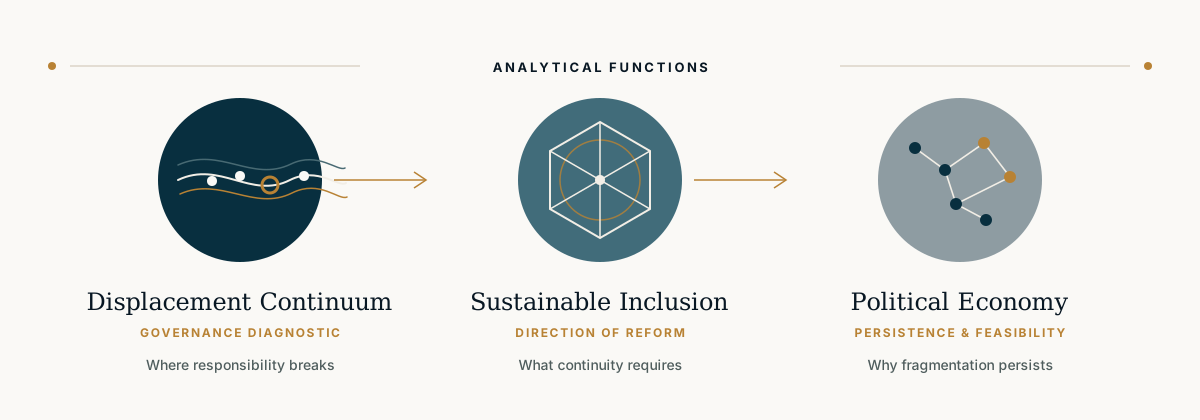
The analytical framework developed by Displacement Policy brings together three connected elements. The displacement continuum is a governance diagnostic that locates the points at which institutional responsibility breaks. Sustainable inclusion examines the institutional arrangements through which displacement-related functions and responsibility can be sustained over time. Political economy explains why fragmentation persists, how institutional interests shape the terms of inclusion, and where reform may be feasible.
Together, these concepts shift the analytical focus from displacement as a sequence of exceptional categories toward the governance architecture through which responsibility is assigned, financed and sustained over time.
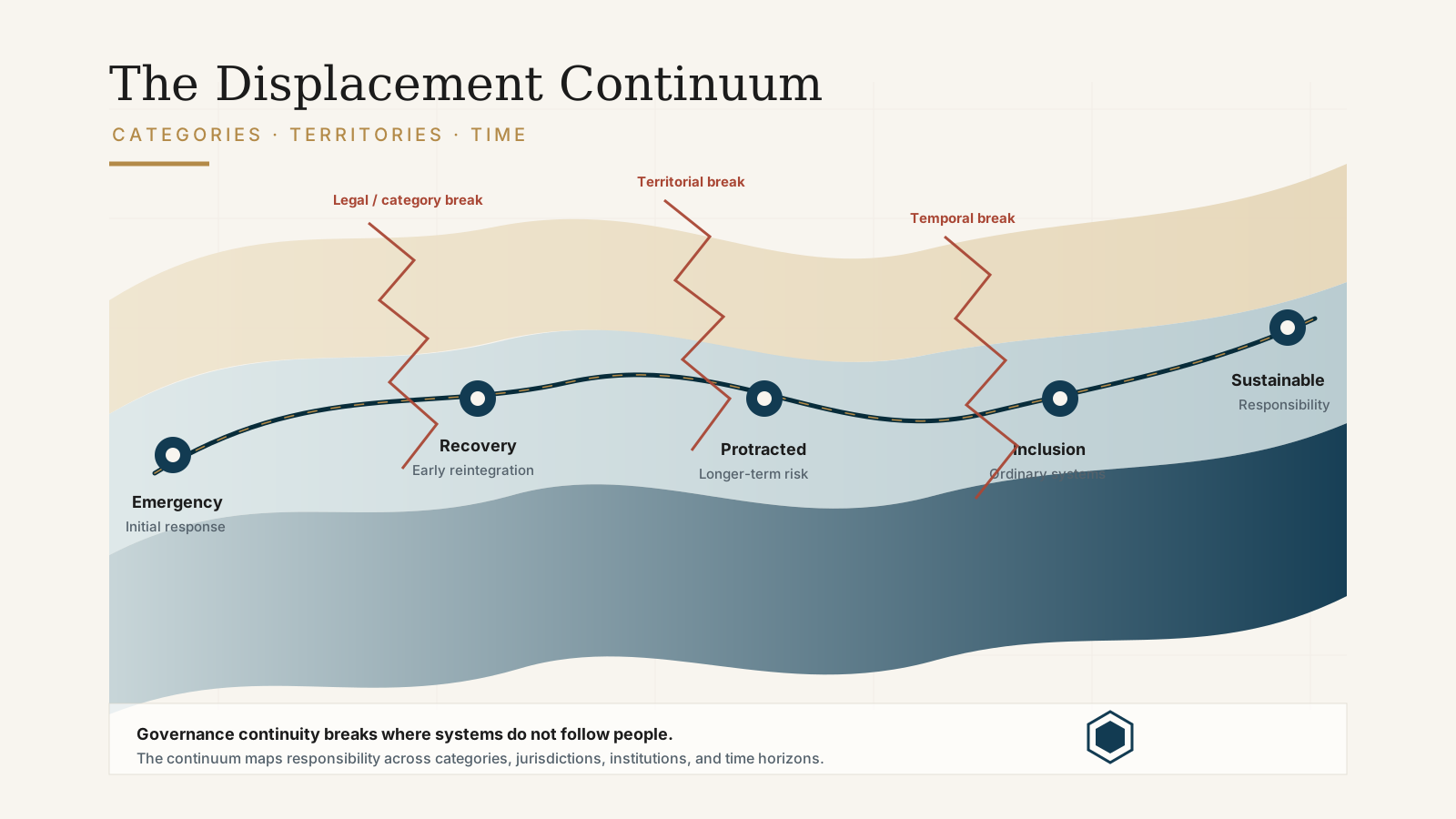
The Displacement Continuum
The displacement continuum begins from a mismatch between the lived reality of displacement and the institutional architecture through which states govern it. For displaced people, movement is often continuous: across borders, districts, legal categories, programmes and successive phases of vulnerability. For governance systems, movement is usually the exception. Eligibility, budgets and administrative responsibility are organised around bounded populations, defined jurisdictions and discrete events.
Applied as a governance diagnostic, the continuum identifies the points at which displaced people cross institutional thresholds but governance architecture does not follow. It therefore shifts analysis from legal status alone to institutional function: which system is responsible, under what mandate, for how long, with what budget authority, and what happens when a person crosses the boundary on which that responsibility depends?
Categorical fault lines
Categorical fault lines arise where legal or administrative classifications determine eligibility and responsibility more rigidly than displacement-related vulnerability. A person may move from recognised refugee to irregular migrant across a border, from disaster-affected household to ordinary social-assistance applicant after an emergency declaration expires, or from project-affected person to resident once a resettlement programme closes. The category changes even when the underlying need for protection or public support does not.
Temporal fault lines
Temporal fault lines arise from the mismatch between time-bounded institutional responses and the longitudinal character of displacement. Emergency powers expire, budget authority reverts, programme eligibility requires requalification and project obligations close, while displacement and its social and economic effects continue. What appears operationally as a transition from response to recovery can therefore become an institutional drop-off in responsibility.
Territorial fault lines
Territorial fault lines arise because governance and public finance are organised territorially while displaced populations move. Registration, service access, social protection eligibility and fiscal transfers are often tied to fixed jurisdictions. When people cross those boundaries, receiving authorities may absorb new costs without corresponding transfers, while administrative records, entitlements and responsibility remain anchored elsewhere.
Where does the system stop following the person?
The analytical contribution of the continuum is to make fragmentation specific and observable. It directs attention to the mechanisms through which discontinuity is produced: eligibility rules, mandate boundaries, budget cycles, registries, territorial financing arrangements and project timelines. Fragmentation is therefore treated not as an abstract coordination problem, but as a predictable outcome of institutional design.
Sustainable Inclusion
If the displacement continuum identifies where responsibility breaks down, sustainable inclusion examines how displacement-related functions and responsibilities can be organised and sustained over time.
Sustainable inclusion is not equivalent to formal legal integration, nor does it require identical status, entitlement or institutional arrangements across all displaced populations. Where legitimate and feasible, displacement-related functions may be incorporated into ordinary national or local systems. In other settings, mixed, international, humanitarian or alternative arrangements may remain necessary where public provision is constrained by capacity, protection concerns, legitimacy or territorial reach.
Three institutional conditions are central.
Systems integration
Systems integration concerns the alignment of eligibility rules, administrative procedures and service-delivery pathways so that displaced populations can access existing systems rather than remain confined to parallel caseloads. Its test is not simply whether access is formally permitted, but whether records, eligibility and service relationships remain functional as circumstances change.
Fiscal integration
Fiscal integration concerns whether displacement-related responsibilities are reflected in workable and sufficiently predictable financing arrangements. Temporary emergency allocations may meet immediate needs, but responsibilities can persist after exceptional financing ends or shift across sectors and jurisdictions as displacement evolves. Financing therefore needs to remain aligned with the institutions carrying responsibility over time. This does not require all displacement-related costs ultimately to become domestic: national or local institutions may deliver public functions while international, concessional, humanitarian or other external resources continue to share the associated costs.
The next question is diagnostic: which fiscal or institutional constraint is preventing sustainable inclusion in a particular setting, and what does that imply for the sector, instrument, financing terms and results chosen in response?
Institutional responsibility
Institutional responsibility concerns mandates that persist across phases of displacement and administrative boundaries. Responsibility must be anchored in authority, accountability and budget capacity, rather than relying solely on voluntary coordination between institutions whose formal mandates remain unchanged.
What institutional arrangements can sustainably carry responsibility as displacement evolves?
Where sustainable inclusion has advanced, it has often done so not by overcoming institutional interests but by working through them: where inclusion reinforces a sectoral mandate, reduces the costs of administrative exclusion, or can be structured in fiscally bounded and politically acceptable ways. The practical question is therefore not only whether inclusion is normatively desirable, but under what institutional configuration it can be sustained.
Political Economy
The persistence of fragmentation within administratively capable states requires an explanation beyond coordination failure. Governance systems embody institutional interests: they define who belongs and on what terms, which institutions exercise authority, how mandates are protected and how fiscal exposure is bounded. Displacement unsettles each of these arrangements.
Membership regimes may rely on temporary or reversible categories that preserve sovereign discretion. Ministries may resist responsibilities that expand their mandate without corresponding authority or resources. Budget systems may prefer temporary and externally financed expenditure to recurrent obligations that become part of the fiscal baseline. Parallel arrangements can therefore persist not because institutions are dysfunctional, but because they allow states and agencies to extend limited protection without altering the underlying distribution of authority, membership or fiscal responsibility.
Political economy also explains why inclusion sometimes becomes possible. Reform can emerge where sectoral objectives align with inclusion, where the administrative or fiscal costs of exclusion become greater than the costs of absorption, or where conditional forms of access can be introduced without requiring broader legal or political incorporation.
Accordingly, reform is not simply a matter of identifying an institutional gap and designing a technically superior solution. It requires understanding the incentives that reproduce the gap and the political, fiscal and administrative conditions under which those incentives can be realigned.
What would make a sustainable allocation of responsibility institutionally and politically feasible?
How the Framework Works
The three elements perform distinct but connected analytical functions.
The displacement continuum
Diagnoses where responsibility fragments across categorical, temporal and territorial boundaries, and identifies the institutional mechanisms producing those discontinuities.
Sustainable inclusion
Examines the institutional conditions and arrangements required to sustain displacement-related functions and responsibility through systems integration, fiscal integration and durable assignment of responsibility.
Political economy
Explains why fragmentation persists, which interests and incentives sustain it, and what forms of institutional change may be feasible.
Used together, the framework moves analysis from the existence of a protection gap to its institutional cause and then to the conditions under which that gap could realistically be closed.
It can be applied across refugee situations, internal displacement, disaster and climate mobility, development-induced displacement, social protection, infrastructure, public finance and other contexts in which people move across institutional boundaries while responsibility remains fixed.
How the Framework Is Used
The framework can be applied to a country, public system, displacement context or financing architecture.
-
Identify the transition points
Where do people move across legal categories, jurisdictions, programmes, institutions or phases of displacement?
-
Locate the discontinuity
Where do responsibility, eligibility, data, services, mandates or financing cease to follow?
-
Identify the institutional mechanism
Which rules, budget arrangements, mandate boundaries, registries, project structures or jurisdictional divisions produce the discontinuity?
-
Identify a sustainable institutional pathway
Which institutional arrangement, public system, mandate, financing mechanism or delivery architecture could sustainably carry the relevant responsibility?
-
Assess political economy and reform feasibility
Which interests and incentives sustain the existing arrangement, and what changes could produce a more workable allocation of responsibility while remaining administratively, fiscally and politically sustainable?
RESEARCH FOUNDATION
Sources
Cheung, Samuel. “Bridging the Fault Lines: The Displacement Continuum and Sustainable Inclusion in Southeast Asia.” In Displacement in Southeast Asia under Neo-geopolitics: Conceptualizations, Intersectional Perspectives, and Creative Responses, Palgrave Macmillan, forthcoming.
Cheung, Samuel. “Governance by Design: The Displacement Continuum and Sustainable Inclusion in Southeast Asia.” Governing Displacement, Policy Brief No. 1, April 2026.